


The 30° grid
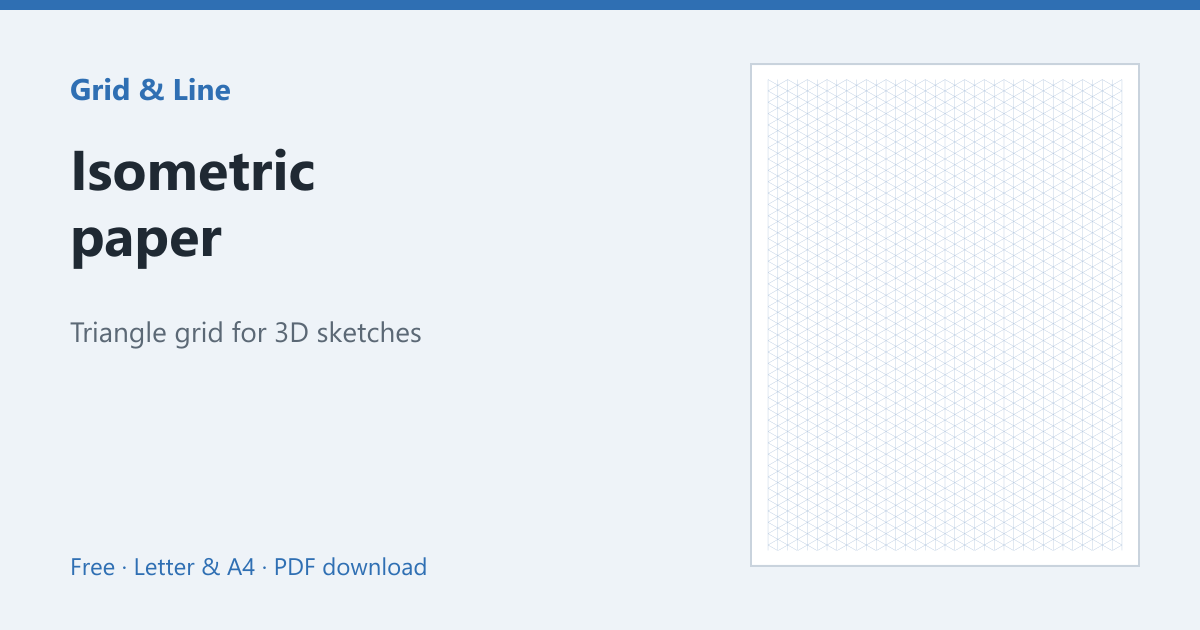
Isometric drawings show three sides of an object at once: a vertical edge and two edges at 30° above the horizontal. The grid on isometric paper repeats those three directions, so equal lengths on the object are equal lengths on the paper. That is why isometric drawings keep their scale along all three axes.
Drawing a cube
- Mark a starting point and draw one vertical line upward.
- From the same point, draw two lines at 30° left and right.
- Mark the same length on all three lines.
- Complete each face with lines parallel to the first three.
What to draw on it
- Product sketches: boxes, furniture and simple machines.
- Architecture: rooms, stairs and building blocks.
- Games: cube maps, terrain and Minecraft-style builds.
- Math: volume, surface area and 3D coordinates.
Line or dot grid
Line grids are easier to follow when you need exact alignment. Dotted grids leave the paper quieter and suit free sketching. Both are available in the isometric paper generator, along with 1/4 inch, 1 cm and custom triangle sizes. For a plain square grid instead, use graph paper.
In practice
A design student sketching a chair needs three faces visible at once. Isometric paper keeps the vertical edge and the two 30° edges on the same scale, so the sketch reads as a solid object rather than a flat front view.
Common mistakes
| Problem | Usually because | What to do |
|---|---|---|
| The cube looks tilted | One edge was not 30° | Follow the printed grid directions |
| Edges have different lengths | Counting grid units unevenly | Mark equal lengths on all three axes |
| The drawing mixes perspectives | Adding vanishing points to an isometric sketch | Keep parallel edges parallel |
 Isometric paper
 Graph paper
 Triangle graph paper